

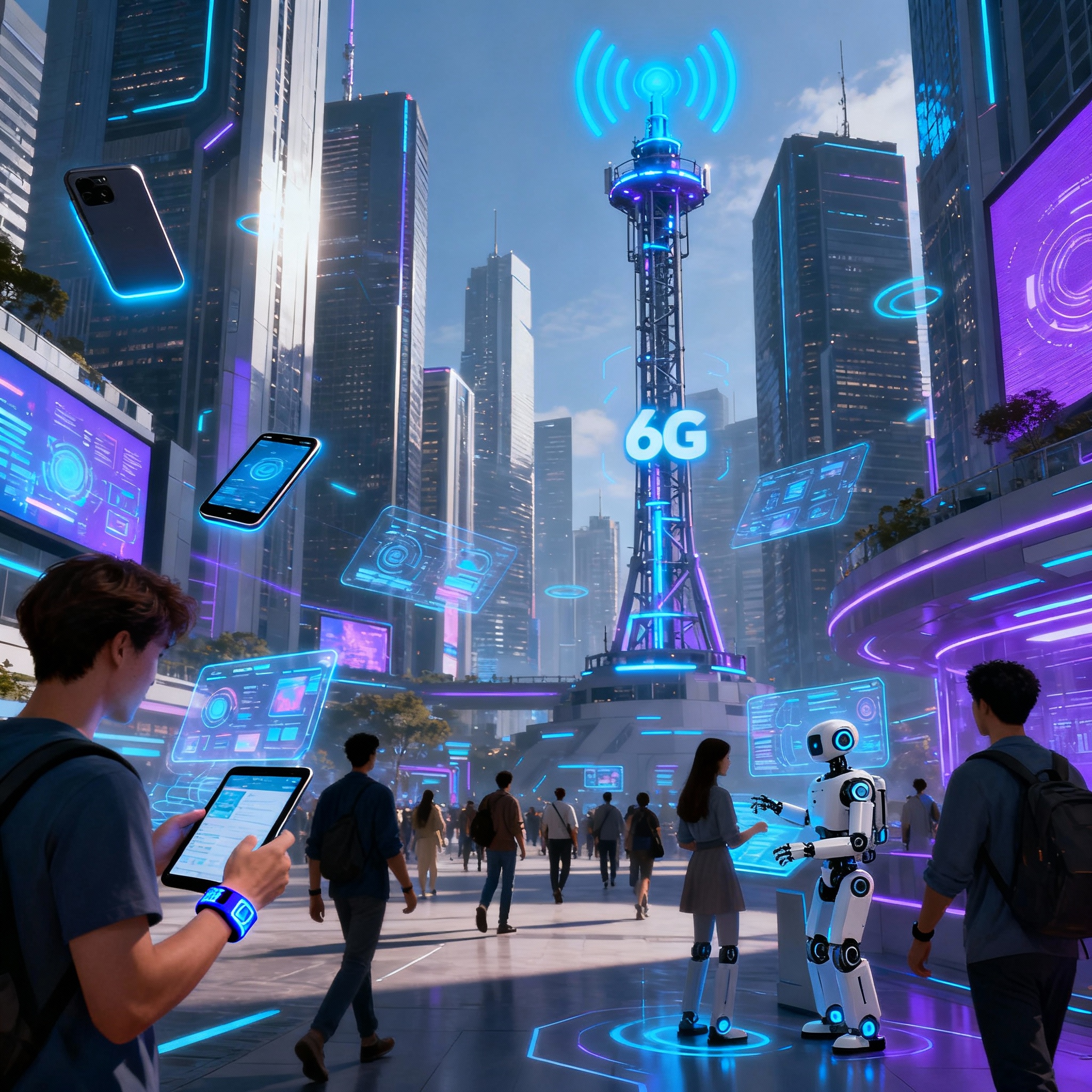
As the world continues to experience the revolutionary effects of 5G technology, the next major leap — 6G — is already in the making. Expected to roll out by 2030, 6G networks promise to completely redefine how humans, machines, and environments connect, interact, and communicate. While 5G focuses on speed and low latency, 6G aims to build a truly intelligent, hyper-connected world that merges the digital, physical, and biological spaces.
1.From Faster Speeds to Smarter Connectivity
6G is not just about faster internet — it’s about intelligent connectivity. Early research suggests 6G could offer download speeds up to 1 terabit per second (Tbps), nearly 100 times faster than 5G. But more importantly, it will integrate AI, machine learning, and edge computing to manage 6networks autonomously.
Imagine your devices adjusting bandwidth, latency, and data flow in real time based on your needs — that’s the level of intelligence 6G aims to deliver.
2.The Rise of Holographic and Immersive Communication
6G will make holographic communication a reality. Instead of video calls, you’ll be able to project full 3D holograms of people into your living space.
This advancement will revolutionize:
- Remote work and meetings
- Telemedicine, allowing doctors to examine patients virtually
- Entertainment and gaming, with lifelike immersive experiences
Combined with extended reality (XR), 6G will merge physical and digital worlds in ways 5G could only begin to imagine.
3.The Internet of Everything (IoE)
While 5G enabled the Internet of Things (IoT), 6G will expand it into the Internet of Everything (IoE) — connecting not only devices but also humans, vehicles, robots, sensors, and even environments.
Smart cities will be able to manage traffic, pollution, and energy consumption autonomously. Autonomous vehicles will communicate seamlessly with infrastructure, ensuring safer and more efficient transportation systems.
4.Ultra-Low Latency and Edge Intelligence
6G aims to achieve latency levels below 0.1 milliseconds, opening possibilities for applications that demand instant response.
This means:
- Remote robotic surgery with zero delay
- Real-time digital twins for industrial automation
- Instant cloud gaming and AR/VR experiences
Edge intelligence — computing closer to where data is generated — will make 6G more efficient, secure, and sustainable.
5.Global Connectivity and Space-Based Networks
One of 6G’s most ambitious goals is universal coverage. By combining terrestrial networks with satellite-based systems, 6G will eliminate connectivity gaps, even in remote regions.
This could finally bring affordable internet access to billions of people who remain offline today, bridging the global digital divide.
6.Security, Privacy, and Sustainability
With every new network generation comes new challenges. 6G will rely heavily on blockchain and quantum cryptography to secure communications. It will also focus on energy efficiency, ensuring faster performance with reduced carbon footprints.
Sustainability will be a key design principle — aligning with global green technology goals.
7.When Can We Expect 6G?
While 6G is still in its research phase, countries like the US, China, South Korea, and Japan are already investing heavily in its development. Commercial deployment could begin around 2030, with pilot projects and testing expected by 2028.
As this technology evolves, it will reshape industries such as healthcare, manufacturing, education, transportation, and entertainment.
Final Thoughts
The transition from 5G to 6G won’t just be an upgrade — it will be a complete transformation of how we connect and experience the world. 6G’s combination of AI, automation, holography, and universal access will create a new era of hyper-connectivity — one that blurs the lines between the physical and digital realms.
The future of connectivity isn’t just faster — it’s smarter, more immersive, and more human-centric than ever before.