Artificial Intelligence (AI) is no longer confined to the world of data analytics, automation, and robotics. It has entered the creative realm—painting portraits, composing music, writing poetry, and even generating movie scripts. What was once considered a purely human domain is now being shared with machines. The result? A redefinition of creativity itself. AI is not replacing artists; it’s transforming the way creativity happens.
AI in Art: Machines That Paint and Imagine
AI-generated art is taking the world by storm. From digital canvases to physical galleries, machine-created artworks are being sold for thousands of dollars. The most famous example is “Portrait of Edmond de Belamy”, a painting created by an AI model developed by Obvious, which sold for over $432,000 at Christie’s.
Modern AI tools like DALL·E, Midjourney, and Stable Diffusion allow anyone to generate stunning artwork within seconds. These platforms use deep learning algorithms to analyze millions of images and styles, enabling users to produce unique compositions simply by typing a prompt.
AI doesn’t just mimic styles—it learns patterns and can create hybrid art forms that never existed before. This democratization of creativity is empowering non-artists to become creators, blurring the line between imagination and execution.
AI in Music: The New Age of Sound
Music, too, has entered the AI revolution. Platforms like AIVA, Amper Music, and Soundful are enabling musicians and producers to compose melodies, harmonies, and even entire soundtracks with minimal input.
AI music tools work by analyzing massive datasets of existing compositions, understanding musical theory, and predicting what sounds will resonate emotionally with listeners. For example, AIVA (Artificial Intelligence Virtual Artist) is capable of composing symphonies in the style of Beethoven or creating electronic tracks for video games and films.
Even mainstream artists are embracing AI. David Guetta famously used AI to generate a “lost Eminem verse” during a live set, showing how machine learning can assist in remixing and reimagining human creativity.
The Rise of Co-Creation: Humans + Machines
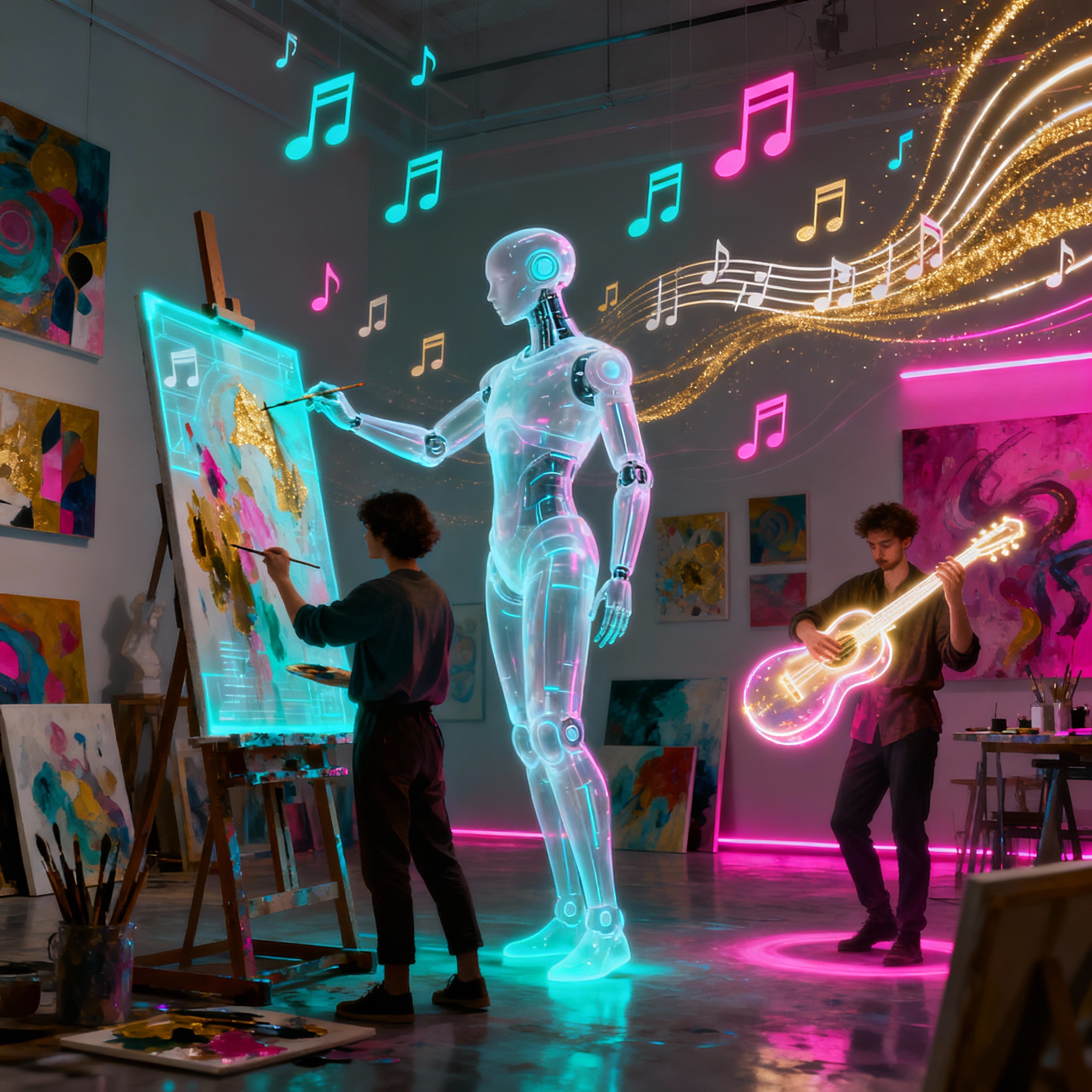
One of the most exciting developments in creative AI is co-creation—where humans and AI collaborate to produce something greater than either could make alone.
Designers use AI to brainstorm visual ideas. Writers employ AI models like ChatGPT for story concepts or dialogue generation. Musicians blend AI-generated chords with their own
compositions. This partnership transforms AI from a simple tool into a creative collaborator.
It’s not about replacing artists but enhancing their creative process—making ideation faster, more experimental, and boundaryless.
Challenges: Originality, Ownership, and Ethics
As AI becomes more creative, a new set of ethical and legal questions arises. Who owns an AI-generated song or painting—the programmer, the user, or the machine itself?
AI art often borrows from vast datasets of existing works, raising concerns about copyright and originality. Critics argue that AI creativity might dilute the value of human-made art, while others believe it expands artistic possibilities.
The biggest challenge lies in maintaining authenticity. True creativity is not just about producing content—it’s about expressing emotion, culture, and experience. AI can mimic these elements, but whether it truly feels them remains a matter of debate.
AI and the Future of Creative Industries
The creative industry is evolving faster than ever. Advertising agencies use AI for branding and content creation. Fashion designers rely on AI to predict trends and design collections. Filmmakers use AI for script analysis, visual effects, and even casting.
In the future, AI may not just assist but actively participate in creative decision-making—helping creators experiment beyond human limits. The synergy of human intuition and machine intelligence could give rise to a new era of digital artistry.
The Democratization of Creativity
Perhaps the most revolutionary impact of AI is how it democratizes creativity. You no longer need years of training to create a song, design a logo, or write a story. AI tools make these skills accessible to anyone with curiosity and imagination.
This accessibility opens doors for millions of people to express themselves in new ways, creating a cultural renaissance powered by algorithms.
Conclusion
AI is not stealing creativity—it’s redefining it. By merging human imagination with machine intelligence, we’re entering a world where anyone can be an artist, musician, or storyteller. The question is no longer “Can machines be creative?” but “How will we use AI to expand our own creativity?”
As technology continues to evolve, one thing is clear: the future of creativity is not human or artificial—it’s beautifully, powerfully both.